

Functions (2M Questions &Solutions)|| V.S.A.Q.’S||
Functions (2M Questions &Solutions): This note is designed by the ‘Basics in Maths’ team. These notes to do help intermediate First-year Maths students.
Inter Maths – 1A two-mark questions and solutions are very useful in IPE examinations.
These notes cover all the topics covered in the intermediate First-year Maths syllabus and include plenty of solutions to help you solve all the major types of Math problems asked in the
IPE examinations.
Functions
QUESTION 1
Find the Domain of the following real-valued functions.
(i) f(x) =
Sol: given f(x) =
It is defined when 6x – x2 – 5 ≠ 0
⇒ x2 – 6x + 5 ≠ 0
x2 – 5x – x + 5 ≠ 0
x (x – 5) –1(x – 5) ≠ 0
(x – 5) (x – 1) ≠ 0
x ≠ 5 or x ≠ 1
∴ domain = R – {1, 5}
(ii) f(x) = 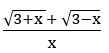
Sol: Given f(x) =
It is defined when 3 + x ≥ 0, 3 – x ≥ 0 and x ≠ 0
⇒ x ≥ –3, x ≤ 3 and x ≠ 0
⇒ –3≤ x, x ≤ 3 and x ≠ 0
⇒ –3≤ x ≤ 3 and x ≠ 0
x ∈ [–3, 3] – {0}
∴ domain = [–3, 3] – {0}
(iii) f(x) = 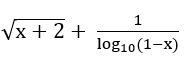
Sol: Given f(x) =
It is defined when x + 2 ≥ 0, 1 – x > 0 and 1 – x ≠ 0
⇒ x ≥ –2, x < 1 and x ≠ 0
x ∈ [–2, ∞) ∩ (– ∞, 1) – {0}
⇒ x ∈ [–2, 1) – {0}
∴ domain = [–2, 1) – {0}
(iv) f(x) =
Sol: Given f(x) =
It is defined when 4x – x2 ≥ 0
⇒ x2 – 4x ≤ 0
x (x – 4) ≤ 0
(x – 0) (x – 4) ≤ 0
x ∈ [0, 4]
∴ domain = [0, 4]
(v) f(x) = log (x2 – 4x + 3)
Sol: Given f(x) = log (x2 – 4x + 3)
It is defined when x2 – 4x + 3 > 0
⇒ x2 – 3x – x + 3 > 0
x (x – 3) –1(x – 3) > 0
(x – 3) (x – 1) > 0
x ∈ (–∞, 1) ∪ (3, ∞)
x ∈ R – [1, 3]
∴ domain = R – [1, 3]
(vi) f(x) = 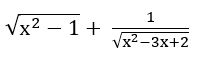
Sol: Given f(x) =
It is defined when x2 – 1 ≥ 0 and x2 – 3x + 2 > 0
(x + 1)(x – 1) ≥ 0 and x2 – 2x – x + 2 > 0
(x + 1) (x – 1) ≥ 0 and x (x – 2) (x – 1) > 0
x∈ (–∞, –1) ∪ (1, ∞) and x ∈ (–∞, –1) ∪ (2, ∞)
∴ domain = R – (–1, 2]
(vii) f(x) = 
Sol: Given f(x) =
It is defined when  – x > 0
⇒ > x
⇒ x < 0
∴ domain = (–∞, 0)
(viii) f(x) =
Sol: Given f(x) =
It is defined when +x ≠0
⇒ ≠ – x
⇒ x > 0
∴ domain = (0, ∞)
QUESTION 2
If f : R→ R , g : R → R defined by f (x ) = 4x – 1, g(x) = x2 + 2 then find (i) (gof) (x)
(ii) (gof) ( ) (iii) (fof) (x) (iv) go(fof) (0).
Sol: Given f(x) = 4x – 1, g(x) = x2 + 2
(i) (gof) (x) = g (f (x))
= g (4x – 1)
= (4x – 1)2 + 2
= 16x2 – 8x + 1 + 2
= 16x2 – 8x + 3
(ii) (gof) ()= (g (f ())
= g(4() – 1)
= g (a + 1 – 1)
= g(a)
= a2 + 2
(iii) (fof) (x) = f (f (x))
= f (4x – 1)
= 4 (4x – 1) – 1
= 16x – 4 – 1
= 16x – 5
(iv) go(fof) (0) = g(fof) (0)
= g (f (f (0)))
= g (f (– 1))
= g (– 4 – 1)
= g (– 5)
= (– 5)2 + 2
= 25 + 2 = 27
QUESTION 3
If f and g are real valued functions defined by f(x) = 2x – 1 and g(x) = x2, then find (i) (3f – 2g) (x) (ii) (fg)(x) (iii)  (x) (iv) (f + g+ 2) (x)
Sol: Given f(x) = 2x – 1 and g(x) = x2
(i) (3f – 2g) (x) = 3f(x) – 2 g(x)
= 3(2x – 1) – 2(x2)
= 6x – 3 – 2x2
(ii) (fg)(x) = f(x) g(x)
= (2x – 1) (x2)
= 2x3 – 3x2
(iii) 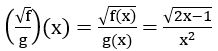
(iv) (f + g+ 2) (x) = f(x) + g(x) + 2
= 2x – 1 + x2 + 2
= x2 + 2x + 1
QUESTION 4
If f = {(4, 5), (5, 6), (6, – 4)} g = {(4, – 4), (6, 5), (8,5)}, then find (i) f + g (ii) f – g
(iii) 2f +4g (iv) f + 4 (v) fg (vi) f/g (vii) (viii)
 (ix) f2 (x) f3
Sol: Given f = {(4, 5), (5, 6), (6, – 4)}
g = {(4, – 4), (6, 5), (8,5)}
The domain of f ∩ The Domain of g = {4, 6}
(i) (f + g) (4) = f (4) + g (4)
= 5 – 4 = 1
(f + g) (6) = f (6) + g (6)
=– 4 + 5 = 1
∴ f + g = {(4, 1), (6, 1)}
(ii) (f – g) (4) = f (4) – g (4)
= 5 – (– 4) = 5 + 4 = 9
(f – g) (6) = f (6) – g (6)
= – 4– 5 = – 9
∴ f – g = {(4, 9), (6, – 9}
(iii) (2f +4g) (4) = 2 f (4) + 2 g (4)
= 2(5) + 4 (– 4)
= 10 – 16
=– 6
(2f +4g) (6) = 2 f (6) + 2 g (6)
= 2(– 4) + 4 (5)
= – 8 + 20
=12
∴ (2f +4g) = {(4, – 6), (6, 12)}
(iv) (f + 4) (4) = f (4) + 4 = 5 + 4 = 9
(f + 4) (5) = f (5) + 4 = 6 + 4 = 10
(f + 4) (6) = f (6) + 4 = – 4 + 4 = 0
∴ (f + 4) = {(4, 9), (5, 10), (6, 0)}
(v) fg (4) = f (4) g (4) = (5) (– 4) =– 20
fg (6) = f (6) g (6) = (– 4) (5) =– 20
∴ fg = {(4, – 20), (6, – 20)}
(vi) f/g (4) = f(4)/g(4) = 5/ – 4 = – 5/4
f/g (6) = f(6)/g(6) = – 4/ 5
∴ f/g = {(4, – 5/4), (6, – 4/ 5)}
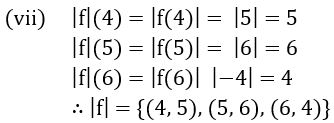
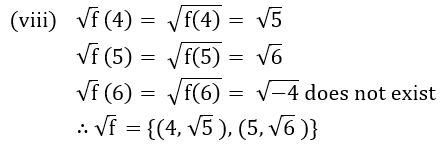
(ix) f2(4) = (f (4))2 = (5)2 = 25
f2(5) = (f (5))2 = (6)2 = 36
f2(6) = (f (6))2 = (– 4)2 = 16
∴ f2 = {(4, 25), (5, 36), (6, 16)}
(x) f3(4) = (f (4))3 = (5)3 = 125
f3(5) = (f (5))3 = (6)3 = 216
f3(6) = (f (6))3 = (– 4)3 = –64
∴ f3 = {(4, 125), (5, 216), (6, –64)}
QUESTION 5
If A = {0, π/6, π/4, π/3, π/2} and f: A→ B is a surjection defined by f(x) = cos x, then find B.
Sol: Given A = {0, π/6, π/4, π/3, π/2}
f(x) = cos x
f (0) = cos (0) = 1
f(π/6) = cos (π/6) =
f(π/4) = cos (π/4) =
f(π/3) = cos (π/3) = 1/2
f(π/2) = cos (π/2) = 0
∴ B = {1, , , ½, 0}
QUESTION 6
If A = {–2, –1, 0, 1, 2} and f: A→ B is a surjection defined by f(x) =x2 + x + 1, then find B.
Sol: Given A = {–2, –1, 0, 1, 2} and f(x) = x2 + x + 1
f (–2) = (–2)2 + (–2) + 1= 4 – 2 + 1 = 3
f (–1) = (–1)2 + (–1) + 1= 1 – 1 + 1 = 1
f (0) = (0)2 + (0) + 1= 0 + 0 + 1 = 1
f (1) = (1)2 + (1) + 1= 1 + 1 + 1 = 3
f (2) = (2)2 + (2) + 1= 4 + 2 + 1 = 7
∴ B = {1, 3, 7}
QUESTION 7
If A = {1, 2, 3, 4} and f: A→ B is a surjection defined by f(x) = then find B.
Sol: Given A = {1, 2, 3, 4} and f(x) =

QUESTION 8
If f(x) = 2, g(x) = x2, h(x) = 2x ∀ x ∈ R, then find (fo(goh)) (x)
Sol: Given f(x) = 2, g(x) = x2, h(x) = 2x
(fo(goh)) (x) = fo (g (h (x))
= f (g (h (x))
= f(g(2x)
= f((2x)2)
= f(4x2) = 2
QUESTION 9
If f: R→ R, g: R → R defined by f (x) = 3x – 2, g(x) = x2 +1 then find (i) (gof-1) (2) (ii) (gof) (x – 1)
Sol: Given f: R→ R, g: R → R defined by f (x) = 3x – 2, g(x) = x2 +1
(i) Let y = f(x) ⟹ x = f-1(y)
y = 3x – 2
y + 2 = 3x
x = (y + 2)/3
f-1(y) = (y + 2)/3
∴ f-1(x) = (x + 2)/3
Now
(gof-1) (2) = g(f-1(2))
= g ((2 + 2)/3)
= g (4/3)
= (4/3)2 + 1 = 16/9 + 1 = 25/9
(ii) (gof) (x – 1) = g (f (x – 1))
= g [ 3(x – 1) – 2)]
= g (3x – 3 – 2)
=g (3x – 5)
= (3x – 5)2 + 1
= 9x2 – 30x + 25 + 1
= 9x2 – 30x + 26
QUESTION 10
If f: N→ N defined by f (x) = 2x + 5, Is onto? Explain with reason.
Sol: Given f (x) = 2x + 5
Let y = f(x) ⟹ x = f-1(y)
y = 2x + 5
2x = y – 5
x = (y – 5)/2 ∉ N
∴ f(x) is not onto
QUESTION 11
Find the inverse of the following functions
(i) If a, b ∈ R, f: R→ R defined by f(x) = ax + b
Given function is f(x) = ax + b
Let y = f(x) ⟹ x = f-1(y)
y = ax + b
y – b = ax
x = (y – b)/a
f-1(y) = (y – b)/a
∴ f-1(x) = (x – b)/a
(ii) f: R→ (0, ∞) defined by f(x) = 5x
Given function is f(x) = 5x
Let y = f(x) ⟹ x = f-1(y)
y = 5x
x =
f-1(y) =
∴ f-1(x) =
(iii) f: (0, ∞) → R defined by f(x) = 
Given function is f(x) =
Let y = f(x) ⟹ x = f-1(y)
y =
x = 2y
f-1(y) = 2y
∴ f-1(x) = 2x
(iv) f: R→ R defined by f(x) = e4x + 7
Given function is f(x) = e4x + 7
Let y = f(x) ⟹ x = f-1(y)
y = e4x + 7
4x + 7 =
4x = – 7
x = ( – 7)/4
f-1(y) = ( – 7)/4
∴ f-1(x) = (  – 7)/4
(v) f: R→ R defined by f(x) = (2x + 1)/3
Given function is f(x) = (2x + 1)/3
Let y = f(x) ⟹ x = f-1(y)
y= (2x + 1)/3
3y = 2x + 1
2x = 3y – 1
x = (3y – 1)/2
f-1(y) = (3y – 1)/2
∴ f-1(x) = (3x – 1)/2
QUESTION 12
If f: R→ R defined by f(x) = , then show that f (tan θ) = cos 2θ
Sol: Given function is f(x) =
f (tan θ) =
∴ f (tan θ) = cos 2θ
QUESTION 13
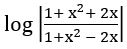
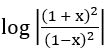
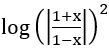
If f: R – {±1} → R defined by f(x) = , then show that
  = 2f (x)
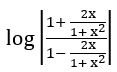
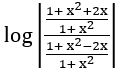
Sol: Given f(x) =
=
= 
= 
= 
=
= 2
∴ = 2f (x)
QUESTION 14
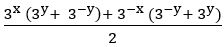
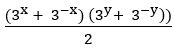
If the function f: R→ R defined by f(x) = , then show that f (x + y) + f (x – y) = 2 f(x) f(y).
Sol: Given function is f(x) =
f (x + y) + f (x – y) = 
= 
=
=
=
=2 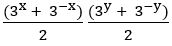
∴ f (x + y) + f (x – y) = 2 f(x) f(y)
QUESTION 15
If f(x) = cos (log x), then show that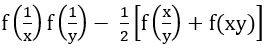 = 0
= 0
Sol: Given function is f(x) = cos (log x)
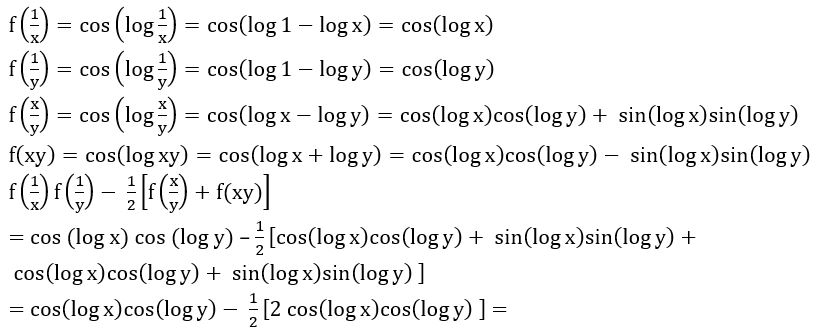
= cos (log x) cos (log y) – cos (log x) cos (log y)
= 0
Hence proved
QUESTION 16
Find the range of the following real-valued functions
Sol:
(i) f(x) =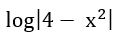
Given function is f(x) =
Let y =
⟹ ey = 
ey > 0
∴ The range of f(x) is R
(ii) f(x) =
It is defined when x – 2 ≠ 0
⟹ x ≠ 2
Domain = R – {2}
let y =
= 
y = x + 2
if x = 2 ⟹ y = 4
∴ Range of f(x) is R – {4}
QUESTION 17
Find the domain and range of the following real-valued functions
Sol:
(i) f(x) =
It is defined when 1 + x2 ≠ 0
⟹ x2 ≠ – 1
x ∈ R
∴ domain of f(x) is R
Let y =
y (1 + x2) = x
y + x2y = x
x2 y – x + y = 0
x = 
It is defined when 1 – 4y2 ≥ 0 and 2y ≠ 0
⟹ 4y2 – 1 ≤ 0 and y ≠ 0
(2y – 1) (2y + 1) ≤ 0 and y ≠ 0
(y – 1/2) (y + 1/2) ≤ 0 and y ≠ 0
– ½≤ y ≤ ½ and y ≠ 0
∴ Range of f(x) is [– ½, ½] – {0}
(ii) f(x) = 
It is defined when 9 – x2 ≥ 0
⟹ x2 – 9 ≤ 0
(x + 3) (x – 3) ≤ 0
– 3 ≤ y ≤ 3
∴ the domain of f (x) is [– 3, 3]
Let y =
y2 = 9 – x2
x2 = 9 – y2
x =
It is defined when 9 – y2 ≥ 0
⟹ y2 – 9 ≤ 0
(y + 3) (y – 3) ≤ 0
– 3 ≤ y ≤ 3
y ∈ [– 3, 3]
∴ Range of f (x) is [0, 3] (∵ y ≥ 0)
(iii) f(x) =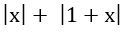
clearly, x ∈ R
∴ domain of f(x) is R
Let y =
If x = 0, then y = 1
If x = – 1, then y = 1
If x = 1, then y = 3
If x = – 2, then y = 3
If x = 2, then y = 5
∴ Range of f (x) is [1, ∞)
(iv) f(x) = [x]
clearly Domain = R and Range = Z
QUESTION 18.
Define (i) One – One function (ii) Onto function (iii) Bijection (iv) Even and Odd functions
(i) One – One Function: one – one, if every element of A has a unique image in B.
(ii) Onto function: A function f: A→ B is said to be onto if ∀ y ∈ B there exists x ∈ A such that f(x) = y.
(iii) Bijection: A function f: A→ B is said to be a Bijection if it is both one-one and onto.
(iv) Even and Odd functions:
If f(–x) = f(x), then f(x) is even function
If f(– x)
= – f(x), then f(x) is odd function
Visit my Youtube Channel: Click on Below Logo